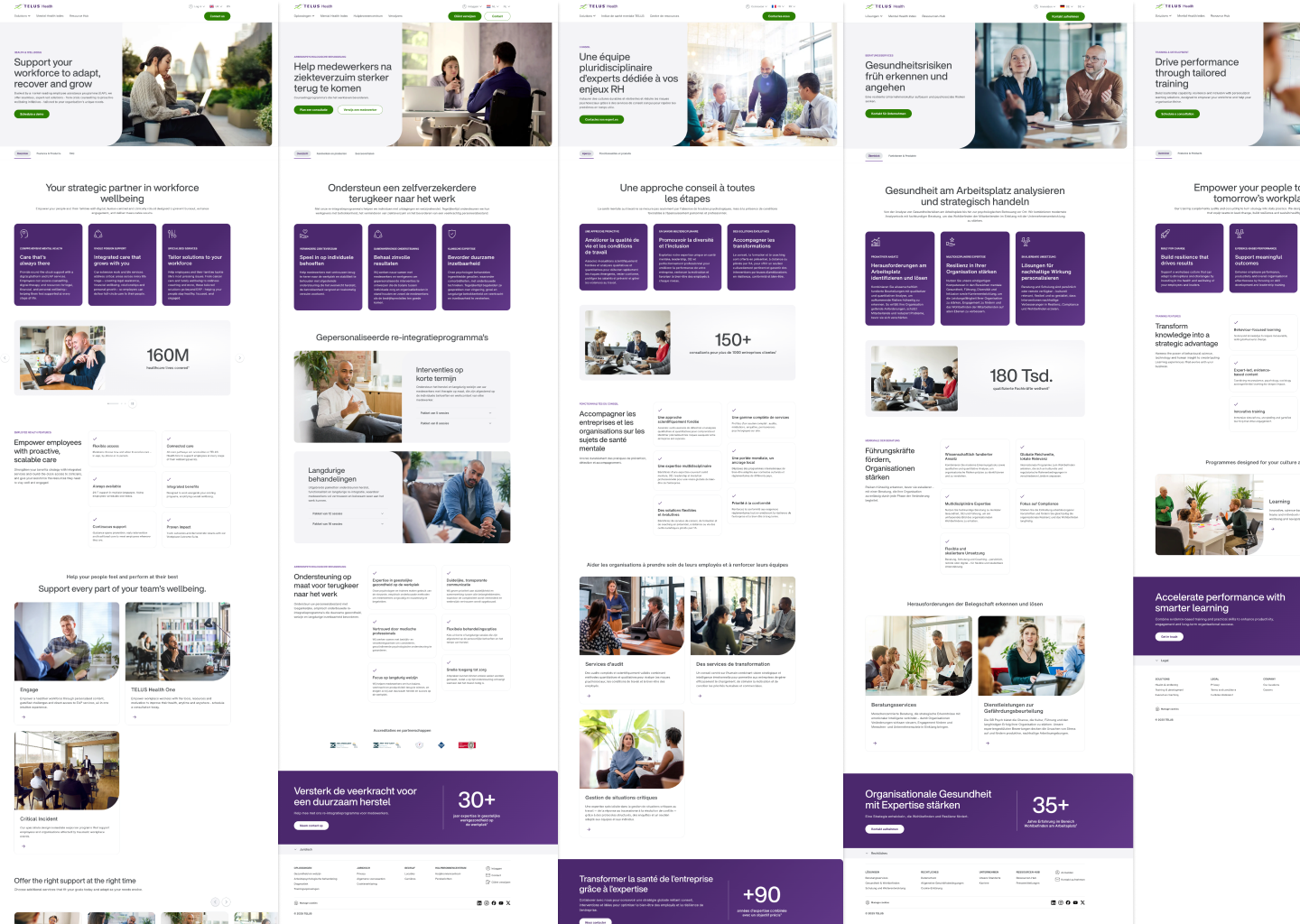
How I delivered 140+ pages of copy for TELUS Health’s global web launch in under 4 months
Website Redesign | AI-Enabled Content Strategy & Copywriting
I partnered with agencies AndSo and Nascent Digital on a brand new website for TELUS Health—a global health and wellbeing benefits provider—which would revamp its digital properties and reposition a rapidly expanding portfolio of services.
Years of growth through acquisitions had created a complex service ecosystem with a fragmented online presence. Externally, prospects struggled to understand what TELUS Health offered and how its services worked together. Internally, teams struggled with duplicated content, competing narratives, regional inconsistencies, and unclear ownership.
Fixing this required approaching content not as a collection of webpages, but as infrastructure to build upon. My role as lead content designer was to unify the organisation’s service offerings, reposition the brand as a strategic partner, and evolve the website into a scalable platform that could support current growth and future business initiatives across markets.
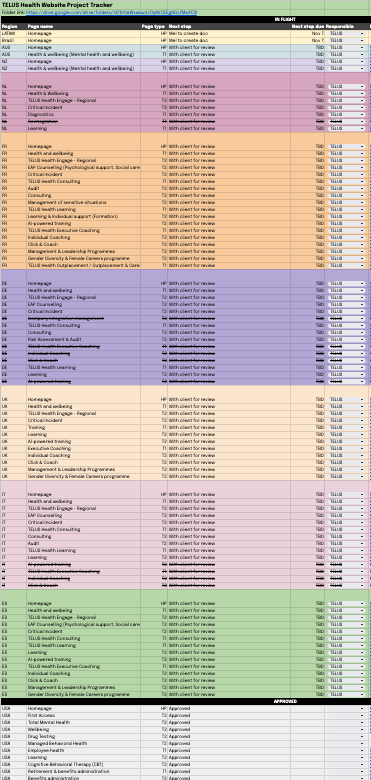
Telling a coherent story across six regional websites
Content problems rarely show up as “content problems.” They sound like:
“People can’t find what we offer.”
“Every region says something different.”
“We keep rewriting the same pages.”
In this case, TELUS Health’s global services—which included EAPs, wellbeing, behavioural health, diagnostics, training, and consulting—were deeply interconnected in practice, but disconnected in how they were articulated digitally.
Rather than treating content as a downstream deliverable, I framed it as a shared strategic process. Our focused discovery sessions ensured we extracted insights and captured expert voices accurately while shaping a clear, consistent narrative for decision-makers.
My team guided stakeholders through targeted questions that explored:
How TELUS Health goes beyond service delivery to act as a strategic partner
How its role has evolved alongside changing workforce needs
How employee wellbeing connects to meaningful organizational outcomes
Which challenges clients solve more effectively through a full continuum of care
The most important USPs at both enterprise and solution levels
How solution sets should be ordered to reflect the employee journey
Each group brought different priorities—branding, compliance, scalability, and regional nuance. Their inputs shaped both the messaging and the site architecture—ensuring the website reflected how clients actually evaluate and adopt services. The end result reflected the input of stakeholders across marketing, UX, design, and development, and centralized global content while still supporting regional localization.
Training AI as a collaborator
With more than 140 pages of content, dozens of services, multiple audiences, and an evolving design system, it wasn’t possible to deliver one copy deck at a time. Systems thinking is what differentiates content design from writing at this scale. My efforts were focused on guidelines and prompts over individual webpages.
This was the largest project I’d undertaken using AI in my workflow, and I was initially concerned it would replace my voice—instead, it demanded that I understand it deeply enough to teach it. LLMs require systems, governance, and human expertise to become effective contributors. AI was able to accelerate execution because I had designed the framework that defined what “good” looked like. Everything comes together as a practical, scalable playbook to integrate AI thoughtfully across product content.
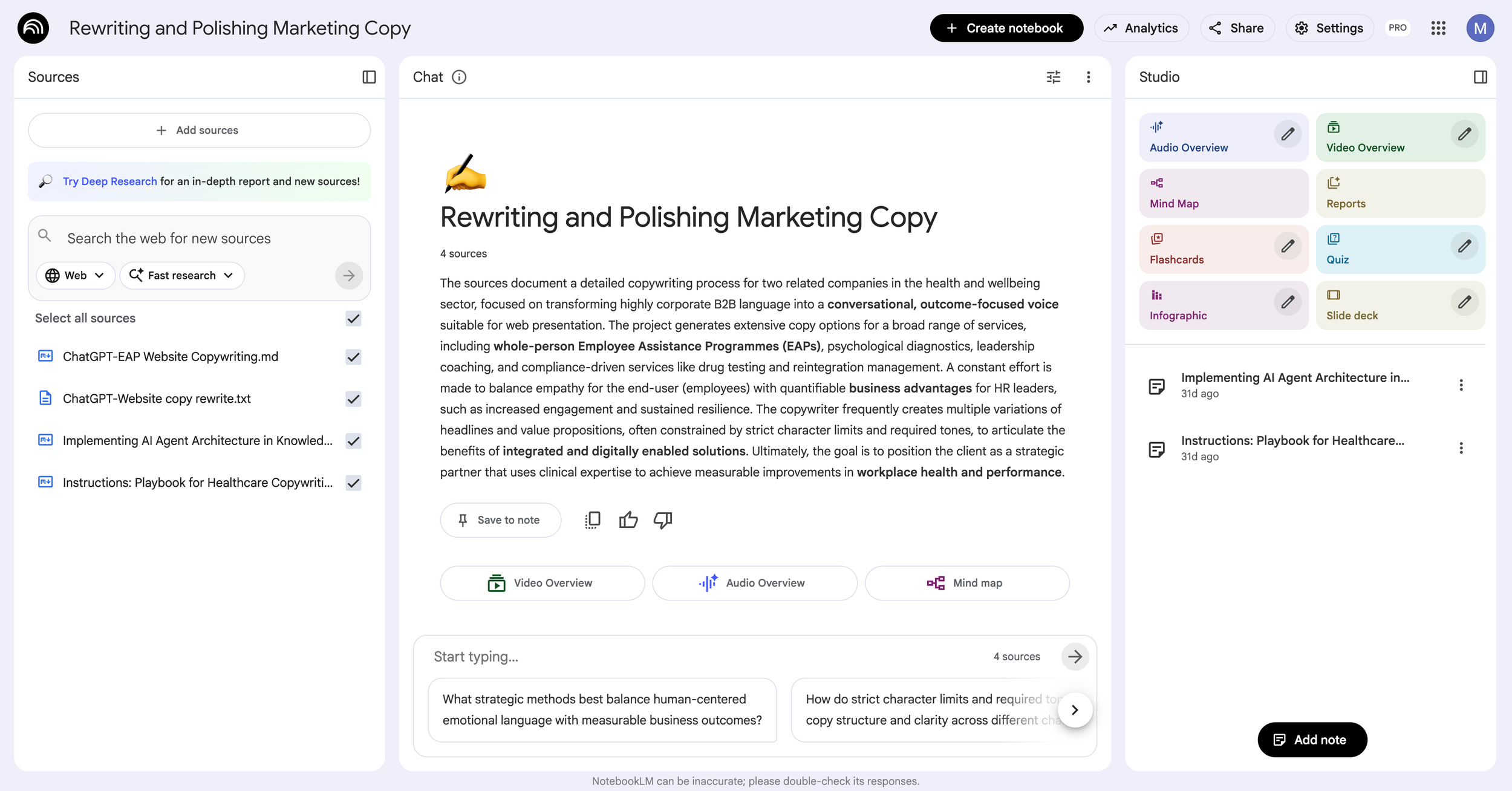
Integrating AI in the revisions process
Client feedback played a crucial role in training AI to iterate on copy. First drafts circulated early in the project to give stakeholders time to react to positioning, tone, and structure—which would influence final wording. I observed how the technology can only power speed when the right prompts ensure fidelity. The biggest challenge of this process was getting AI to balance human-centred language with business outcomes, which had to be built in as a constraint—refining language that could honour wellbeing while clearly communicating performance, resilience, and organizational effectiveness.
Once the feedback system was in place, execution moved quickly. I worked with one other contributor to write and refine 140+ pages in under four months, distilling years of inconsistent source material into a unified, value-driven narrative that ensured each copy deck was treated as part of a larger story, not a standalone artefact.
Having this framework also made collaboration easier across distributed teams. Shared patterns, decision logic, and examples created a common language that reduced friction, accelerated internal reviews, and kept everyone aligned, regardless of role or location.
Delivering global outcomes
Qualitatively, the impact was immediate:
A unified narrative replaced years of fragmented messaging
Teams gained shared language across sales, onboarding, and partnerships
The website evolved into a strategic platform—not just a marketing channel
Content was successfully localised and translated across four continents, maintaining a consistent global story while allowing for regional nuance and regulatory realities
This work reinforced my belief that it takes a content designer’s judgment—not just AI tools—to produce content that reflects strategy, supports user needs, aligns with brand and UX constraints, and holds up under organizational and geographic complexity. AI needs human intelligence to build a content strategy capable of sustaining a product long after the initial launch.
That capability comes from defining the strategy behind the words, aligning stakeholders around a shared narrative, and designing systems that preserve meaning at scale.
By building clear guardrails and a flexible content system, I was able to automate repetitive writing tasks without sacrificing tone, intent, or contextual relevance—globally or locally. The result marked a shift in my practice from executing content to designing the systems that make content scalable, translatable, and durable. Those systems enabled AI to deliver high-quality, contextually relevant outputs while remaining aligned with brand, UX, compliance, and business goals—no matter the market.